Understanding University Grace Marks: Statutory Frameworks, Score Adjustments & Transcript Impact
How Are Grace Marks Awarded in Indian Universities?
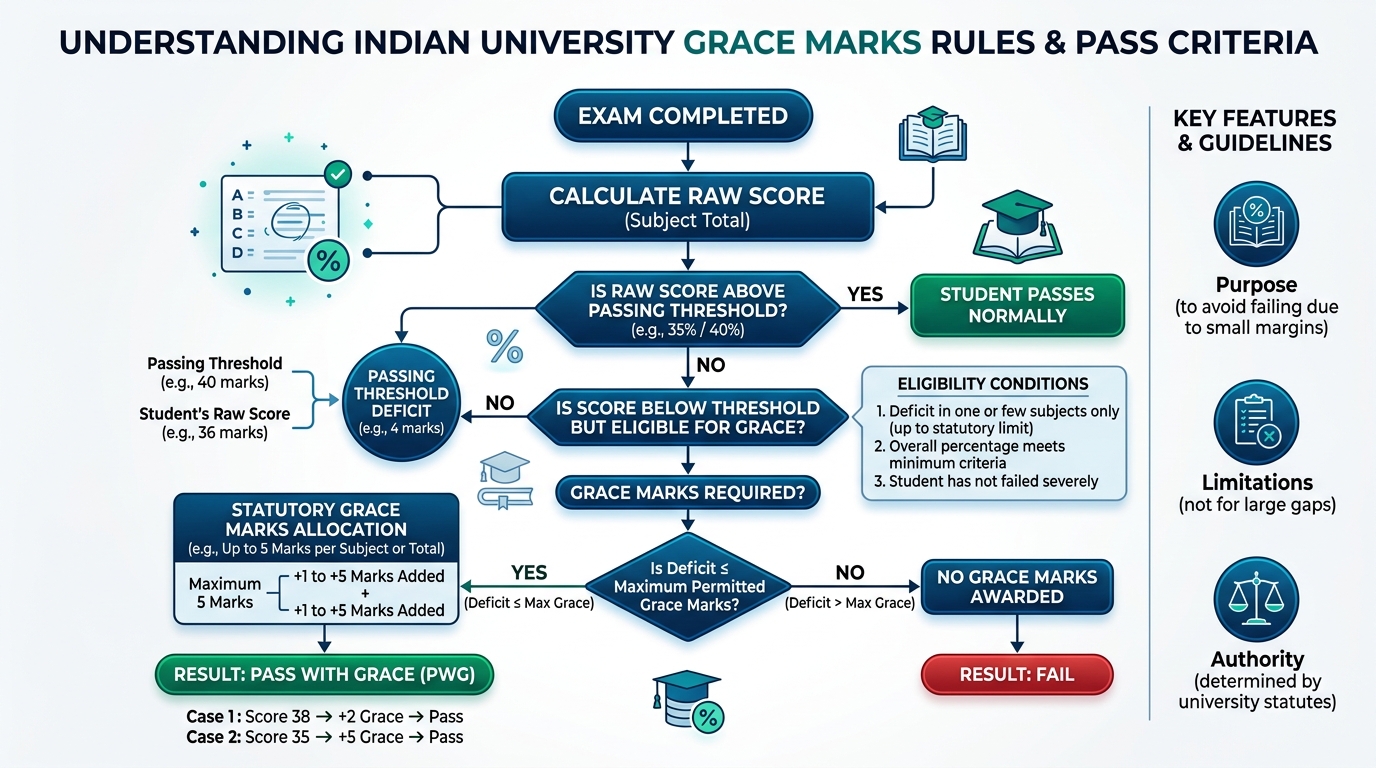
In Indian collegiate examination systems, grace marks represent an institutional safety net designed to bridge razor-thin evaluation deficits. Rather than penalizing a diligent student with an entire semester backlog over a minor 1 to 5 mark shortfall in an external written exam, university senates enact statutory ordinances. These provisions empower automated grading systems to supplement marginal scores (such as lifting 28/100 or 18/70) up to the mandatory minimum passing threshold.
- Automated Backend Execution: Exam tabulation software calculates and credits eligible marks during final result compilation without requiring manual student petitions.
- Restricted to Written Theory: Statutory gracing applies strictly to external end-semester theory papers—never to internal continuous assessments (CIE), lab practicals, or project vivas.
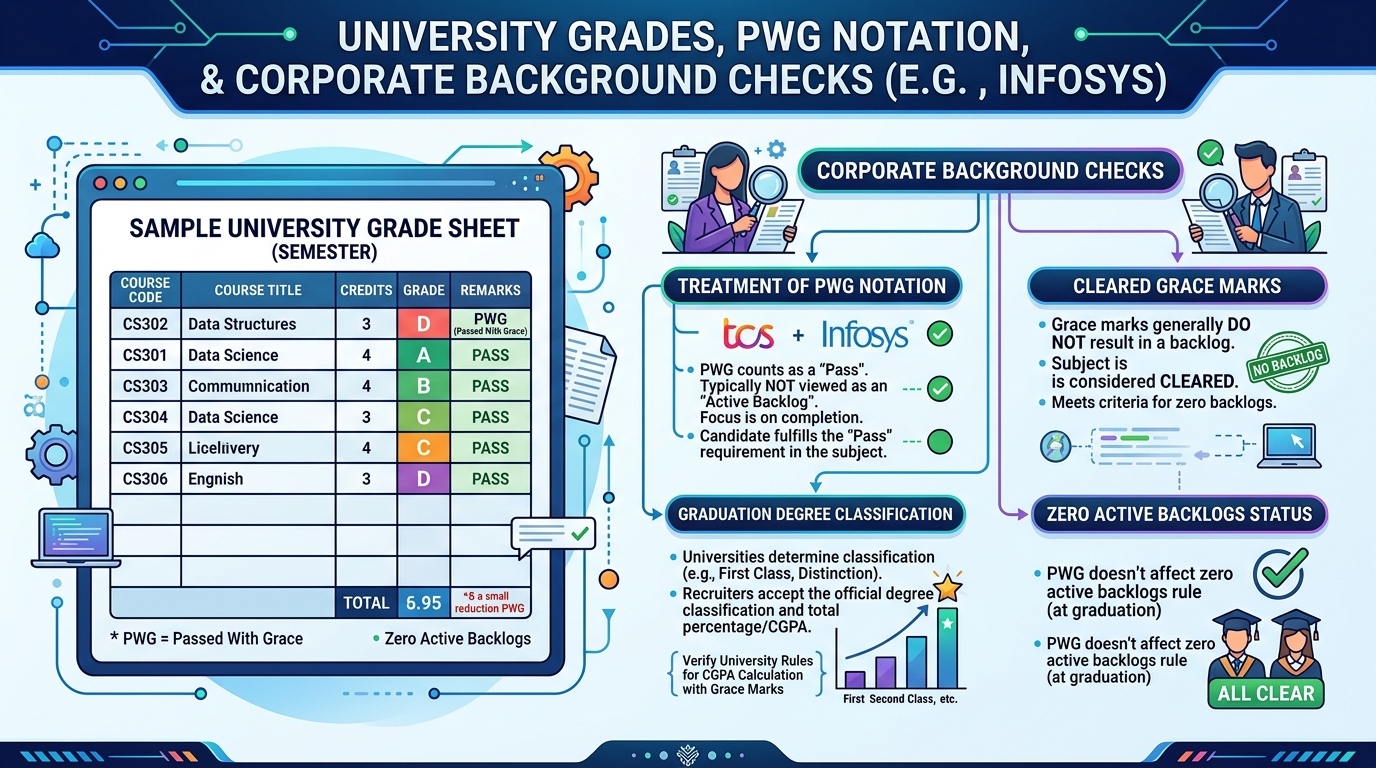
- Transcript Markings: Grade cards identify the intervention through administrative codes such as PWG (Passed with Grace), P(G), or formal statutory symbols (# or 0.5042).
- Corporate Placement Stance: Top recruiters (including TCS, Infosys, and Wipro) treat graced courses as completed papers with zero active arrears, preserving campus placement eligibility while distinguishing recipients from university rank-holders.
The Academic Dilemma: When 1 Mark Threatens an Entire Semester
Semester evaluations across technical institutes and conventional universities operate on exacting cutoffs. Falling short of an individual paper threshold by a mere statistical fraction—such as scoring 29 out of 100 when the pass line is 30, or 20 out of 70 against a 21 cutoff—sparks compounding academic setbacks:
- Campus Placement Bars: Active backlogs trigger immediate exclusion during enterprise corporate screening windows.
- Year-Back Progression Risks: Failing to satisfy annual credit advancement rules (often requiring at least 50% cleared subjects under Choice-Based Credit Systems) delays whole degree progression.
- Forfeiture of Merit Waivers: Government fee concessions and merit scholarship disbursements routinely pause upon logging an uncleared subject.
To buffer examinees against handwriting evaluation variations, statutory examination boards aligned with the University Grants Commission (UGC) and the AICTE Examination Reforms enact structured gracing policies. This interactive University Grace Marks Calculator & Pass Estimator models official university frameworks, enabling you to test raw scores, understand how to calculate grace marks for passing, and review the genuine placement implications of a "Passed with Grace (PWG)" grade card.
When Grace Marks Safeguard Your Degree vs. Statutory Restrictions
1. Structural Benefits of Statutory Gracing
- Active Arrear Elimination: Instantly converts a failing grade into an officially cleared course, securing an unblemished record of zero live backlogs for recruitment rounds.
- Protects Promotion Momentum: Enables undergraduates to hit minimum annual credit thresholds needed to move into higher academic years.
- Unbiased Automated Processing: Handled objectively through central examination algorithms per published statutes, eliminating administrative delays.
- Protects Graduation Schedules: Prevents losing an entire 6-month semester cycle waiting for odd/even backlog re-examinations.
2. Institutional Limitations & Transcript Scrutiny
- Exclusion from Gold Medals & Honors: University statutes restrict academic medals, departmental ranks, and "First Class with Distinction" honours solely to examinees passing cleanly without compensatory assistance.
- Permanent Semester Notation: Grade transcripts retain indelible administrative markers like PWG, P(G), or statutory article codes.
- Restricted Exclusively to Theory: Statutes explicitly bar gracing internal continuous assessments, laboratory practicums, or project evaluations.
- Strict Annual Aggregate Ceilings: Once the yearly credit quota (commonly 7 to 10 marks per session) is consumed, any additional failing subjects stand as formal active arrears.
- Overseas Transcript Audits: Competitive foreign graduate schools (e.g., German TU9 institutions or premier US graduate programs) reviewing detailed transcripts may request official clarification for asterisked notations.
Legal Mechanics: Grace Marks vs. Moderation vs. Condonation
These three academic remedies fulfill fundamentally distinct regulatory roles across Indian collegiate administrations:
| MECHANISM | BENEFICIARY SCOPE | MARKSHEET INDICATION | ADMINISTRATIVE INTENT |
|---|---|---|---|
| 1. Statutory Gracing | Individual borderline examinee | Visible tag (PWG, P(G), #) | Overcomes narrow paper-level deficit to reach pass mark |
| 2. Cohort Moderation | All test takers across subject | Unmarked (Direct mark enhancement) | Neutralizes flawed, ambiguous, or out-of-syllabus questions |
| 3. Attendance Condonation | Students facing medical / activity shortages | ERP / Admit Card Notation | Permits 65%–74% attendance cases to sit for examinations |
Individual Grace Marks (Subject Deficit Relief):
Personalized score support granted to an individual scholar to bridge a marginal shortfall (1 to 5 marks) in one or two theory examinations. The resultant semester marksheet features an asterisk (*), PWG, or specific ordinance code.
Cohort-Wide Scaling & Moderation:
Systemic calibration enacted by university review panels when an examination paper is deemed unusually difficult, contains misprints, or has translation ambiguities. Every student who sat for that paper receives compensatory marks with zero adverse transcript notations.
Classroom Attendance Condonation:
Deals with examination hall admission rather than academic marks. While university guidelines universally establish a 75% attendance benchmark, institutional deans possess discretionary authority to condone up to a 10% deficit (permitting 65%–74% attendees) against certified medical records or university sports duties. Model your class schedule and lecture attendance anytime using our College Attendance Calculator & Bunk Planner.
Tactical Scenarios: How Universities Apply Grace Rules (Case Studies)
Case Study 1: Engineering Semester Candidate (3-Point Deficit)
Scenario: A B.Tech student secures 27 out of 100 in Discrete Mathematical Structures, where the external theory cutoff is fixed at 30 marks. The candidate cleared all laboratory practicals and other theory courses with strong scores.
Deficit Evaluation: Shortfall = 30 − 27 = 3 Marks
Ordinance Provision: Institutional rule permits up to 5 compensatory marks per paper
Outcome: 3 grace marks credited → Status: Passed with Grace (PWG)
Career Outcome: The student holds zero active backlogs, preserving complete eligibility for corporate placement drives.
Case Study 2: Multi-Course Deficit Crossing the Session Cap
Scenario: An examinee experiences multiple narrow shortfalls: missing 4 marks in Digital Signal Processing, 4 marks in Microprocessor Systems, and 4 marks in Control Theory (Total required: 12 marks). The university caps aggregate yearly relief at 10 marks.
Subject 1 (gap: 4m) → Cleared via 4 grace marks
Subject 2 (gap: 4m) → Cleared via 4 grace marks
Subject 3 (gap: 4m) → Only 2 marks left in cap → Active Arrear (Backlog)
Mandatory Action: The candidate clears two courses under statutory limits; the third subject must be re-registered as a Carry Over Paper (COP / Arrear) during the next examination sitting.
Tactical Decision Guide: Accept Grace Marks or Apply for Re-Evaluation?
Evaluating marginal scores requires strategic foresight before academic records are permanently locked:
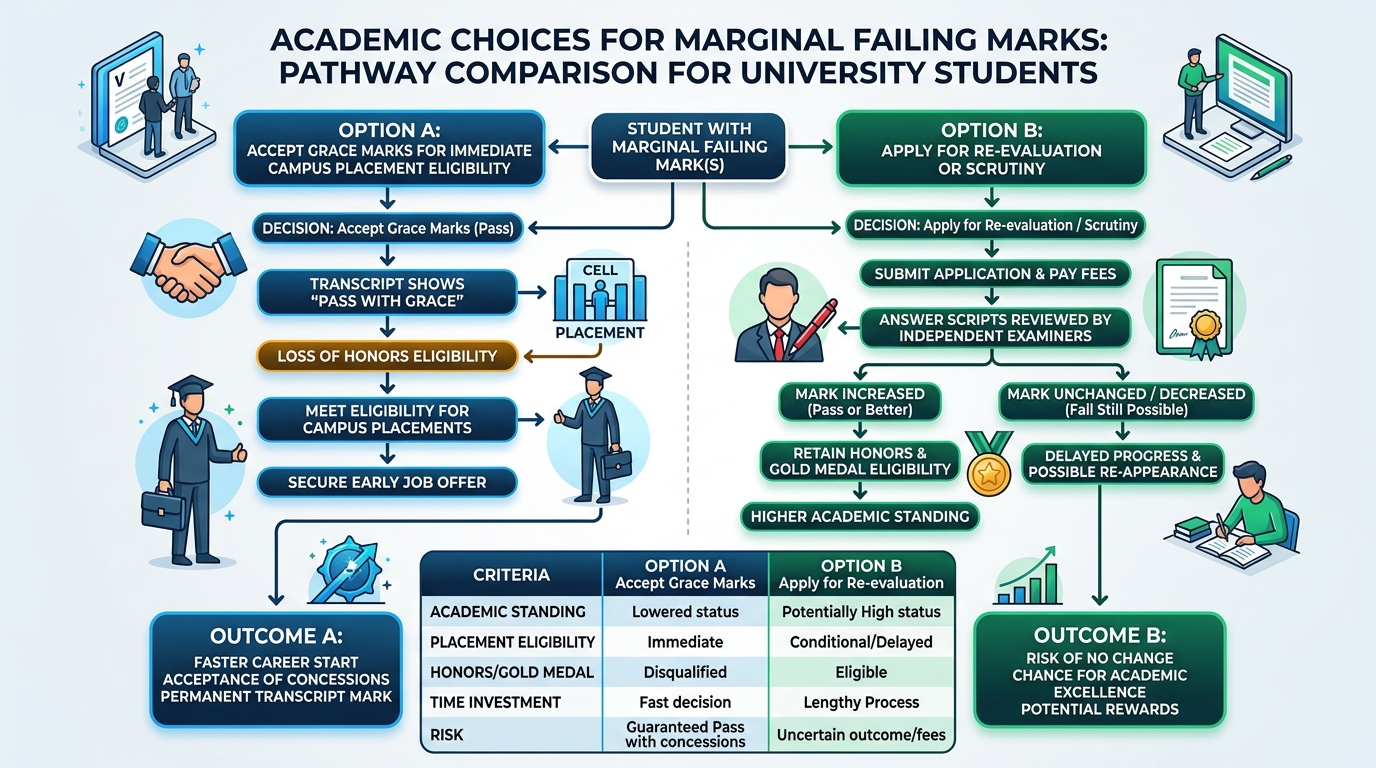
If trailing by merely 1 or 2 points, submit an official re-checking petition. Administrative recounts and unchecked step verifications frequently reclaim missing points cleanly, yielding an unblemished standard grade. Calculate required score thresholds with our Grade Improvement Calculator.
Scholars holding an 8.5+ CGPA targeting departmental ranks or distinction honors can submit an institutional grace surrender request within 15–30 days of result declaration, enabling them to re-appear for an unblemished grade.
Whenever on-campus job drives require zero live arrears, accepting the automated grace result is pragmatic. Enterprise employers focus on cleared status rather than administrative notations.
Compensatory quotas do not reset between semesters; they represent a single yearly allowance (e.g., 10 marks total). Consuming the ceiling during winter exams leaves zero safety net for spring term courses.
Integrated Tools: How Do You Calculate Your Final Mark & Average Percentage?
1. Graduation Marks Percentage Computation Formula
When completing government recruitment portals (UPSC, State PSC, SSC) or postgraduate application forms (GATE, CAT), convert cumulative scores using this standardized equation:
Practical Illustration: Earning an aggregate of 3,850 marks out of 5,000 maximum possible equates to: (3850 / 5000) × 100 = 77.00%. Generate certified PDF verification slips instantly on our Official Conversion Certificate Generator.
2. Determining Mean Semester Scores
To evaluate the arithmetic average across N evaluated courses in a given term:
In credit-weighted curriculum designs (CBCS), calculate the weighted average instead: Weighted Average = ∑(Course Credits × Marks Earned) / ∑ Total Semester Credits. Employ our SGPA to Percentage Calculator to convert single-term SGPA into official percentage equivalents.
3. Utilizing a "What If" Grade Calculator for Academic Planning
A "What If" score projection model reveals the minimal marks needed on upcoming tests to preserve a target degree division. When an earlier paper relied on grace assistance, compute the required future score using:
To forecast upcoming semester metrics effortlessly, try our Target CGPA & Required SGPA Predictor or establish written test passing cutoffs with our Semester Pass Marks Calculator.
Frequently Asked Questions (People Also Ask)
Can I pass an exam paper with grace marks?
Yes. Whenever a candidate's theory score falls short of the mandatory pass line by an amount within the university's approved examination statutes (generally between 1 and 5 marks), the institutional grading software automatically supplements the deficit to deliver a passing result.
What does "Passed with Grace" (PWG) or "P(G)" denote on an academic grade card?
This designation signifies that while the raw examination score missed the baseline theory passing mark, the university applied statutory compensatory points to upgrade the subject to a cleared status.
Does a "Passed with Grace" (PWG) mark negatively affect on-campus job placements?
Under standard corporate recruitment norms, no. Tier-1 enterprise recruiters (such as TCS, Infosys, and Wipro) assess overall aggregate percentages (typically 60%+ or a 6.5 CGPA threshold) and verify that the candidate possesses zero live, uncleared backlogs. Since a graced paper is formally completed, it fulfills eligibility criteria.
Is scoring 27 out of 80 classified as a pass or fail?
Central School Boards (CBSE Class 10 & 12): Scoring 27 out of 80 represents a pass, as the 33% passing requirement computes to 26.4 marks (rounded up to 27).
Technical Engineering Universities (AKTU, RTU, VTU): Most technical institutes mandate a 40% benchmark (requiring 32 out of 80). In that setting, 27 out of 80 is short of passing, though an examinee may qualify for up to 5 compensatory grace marks under applicable university ordinances.
Can school boards like CBSE grant 10 grace marks?
No. CBSE does not provide 10 discretionary marks to individual test takers. Under Rule 43 of the board's Examination Bye-Laws (verifiable on the CBSE Official Portal), the board utilizes question paper moderation for anomalous or overly difficult questions, alongside restricted discretionary committee review (generally 2 to 5 marks) in borderline cases, rather than blanket 10-mark additions.
Can grace marks compensate for failing internal practicals, labs, or vivas?
No. Examination ordinances across Indian universities universally confine statutory gracing to written external end-semester theory papers. Internal assessments, laboratory experiments, continuous sessionals, and viva voce evaluations require students to meet pass cutoffs independently.
How are grace marks recorded and awarded in university results?
Gracing is executed entirely through computerized tabulation software during result generation. The automated system checks failing marks against predefined ordinance limits. When a student qualifies within both paper-level and session-level caps, the adjustment is recorded directly without requiring personal requests or paperwork.
How can I convert an academic grade back into raw marks?
Under UGC Choice Based Credit Systems (CBCS), grades translate to numerical percentages through published institutional equations (such as Percentage = CGPA × 9.5 or (CGPA − 0.75) × 10). Multiplying this percentage by the program's total maximum marks delivers your equivalent score. Find all university equations on our Academic Utilities Hub.
Does the final degree convocation certificate indicate "Passed with Grace"?
No. Notations like PWG or ordinance numbers are recorded exclusively on individual semester marksheets. The final graduation diploma and convocation degree certificate awarded by the university record only your degree title, major, and overall division or classification.