JNTUH CGPA to Percentage Calculator | Official Clause 11.2 Formula, TS EAMCET Cutoffs & Degree Norms
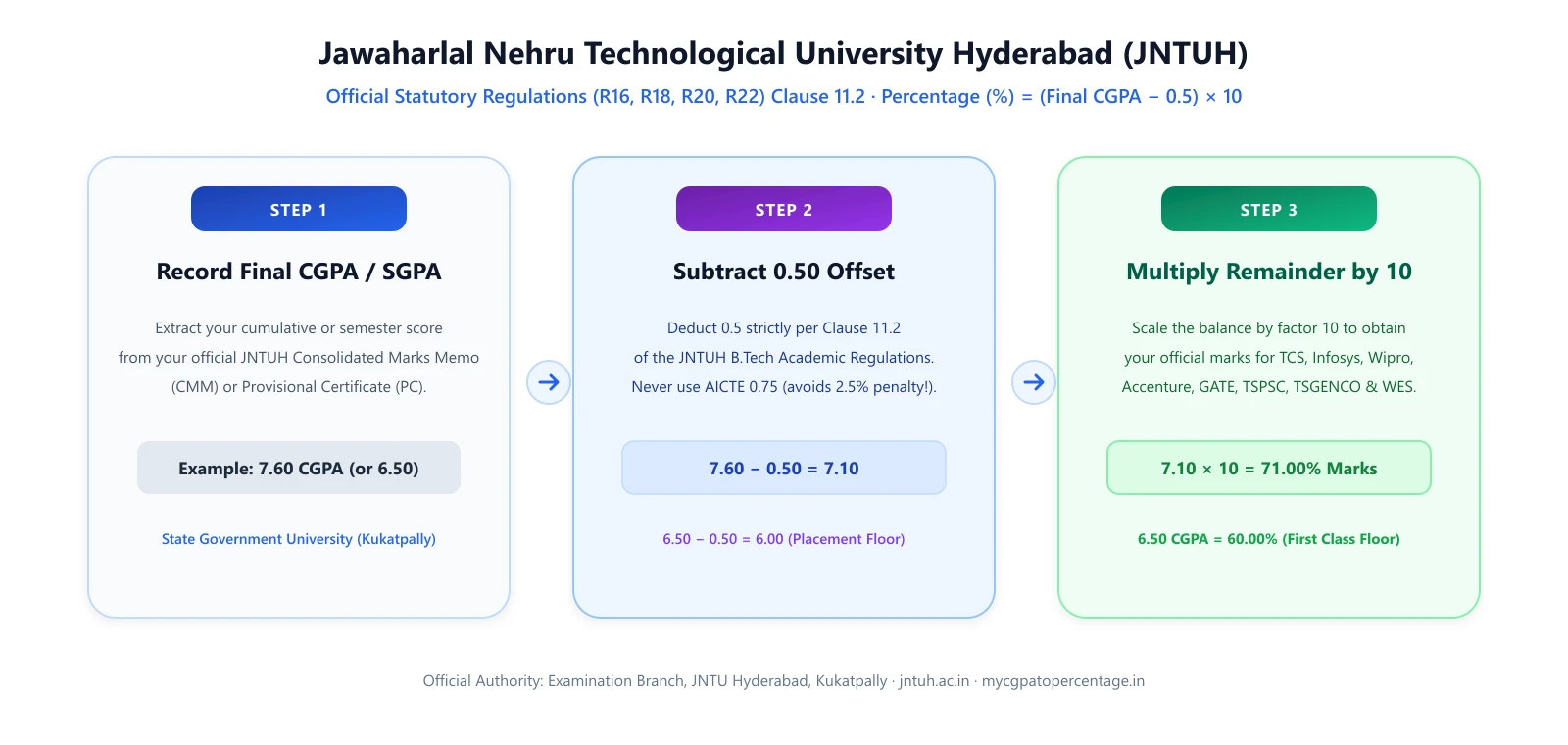
Under statutory Clause 11.2 of the B.Tech Academic Regulations (covering R16, R18, R20, and R22 CBCS frameworks) ratified by the Academic Council and Examination Branch of Jawaharlal Nehru Technological University Hyderabad (JNTUH), cumulative grade points convert into aggregate percentage marks through the uniform linear model:
Percentage (%) = (SGPA − 0.5) × 10- Universal 60% Corporate Recruitment Gate: An aggregate score of 6.50 CGPA yields exactly (6.50 − 0.5) × 10 = 60.00% marks, clearing corporate screening thresholds for TCS, Infosys, Wipro, Cognizant, Accenture, and Deloitte.
- Distinction Standing (75% Benchmark): Achieving a cumulative index of 8.00 CGPA translates to (8.00 − 0.5) × 10 = 75.00% marks, conferring First Class with Distinction honours.
- Protection Against the 2.50% AICTE Penalty: Generic web calculators mistakenly apply AICTE's
(CGPA − 0.75) × 10formula, which unjustifiably strips 2.50 percentage points from JNTUH students (turning 6.50 CGPA into 57.50% and causing ATS screening disqualification). Clause 11.2 guarantees your rightful marks. - Institutional Jurisdiction: Codified by the Examination Branch, JNTU Hyderabad, Kukatpally. Printed on the reverse legend of official Consolidated Marks Memos (CMM) and Provisional Certificates (PC) across 400+ constituent and affiliated colleges in Telangana.
1. About JNTU Hyderabad (JNTUH): Historical Legacy, Campus Scale & Governance
Originally established in 1965 as The Nagarjuna Sagar Engineering College and reconstituted in 1972 under the Jawaharlal Nehru Technological University Act by the Andhra Pradesh State Legislature, Jawaharlal Nehru Technological University Hyderabad (JNTUH) was India's first technological university. In 2008, under the landmark JNTU Act, 2008 (AP Act No. 30 of 2008), the historical institution was partitioned into four autonomous universities: JNTU Hyderabad (JNTUH), JNTU Kakinada (JNTUK), JNTU Anantapur (JNTUA), and JNAFAU Hyderabad.
Operating from an expansive 890-acre eco-friendly campus in Kukatpally, Hyderabad, JNTUH serves as the premier governing technical institution in Telangana. The university directly oversees more than 400+ affiliated undergraduate engineering colleges, postgraduate institutes, and pharmaceutical research centers, catering to over 3,00,000 active students.
Curricular Frameworks & Specialized Academic Streams
Campus Infrastructure & Apex Affiliated Colleges
- University College of Engineering Science & Technology Hyderabad (UCESTH): The flagship constituent autonomous technical institution situated inside the Kukatpally campus, renowned for top NIRF ranking and cutting-edge labs.
- Dr. B.R. Ambedkar Central Library: Sprawling multi-storey library facility holding over 1,50,000 academic volumes, IEEE Xplore digital licenses, ScienceDirect repositories, and reprographic facilities.
- Premier Affiliated Engineering Network: Includes Telangana's top autonomous colleges such as Chaitanya Bharathi Institute of Technology (CBIT), Vasavi College of Engineering, VNR Vignana Jyothi Institute of Engineering & Technology (VNR VJIET), Gokaraju Rangaraju (GRIET), Mahatma Gandhi Institute of Technology (MGIT), and CVR College of Engineering.
- Directorate of University Industry Interaction (UIIC): Centralized placement coordination cell executing recruitment drives with tech giants including Microsoft, Amazon, Oracle, ServiceNow, TCS, Infosys, and Deloitte.
2. Official JNTUH CGPA to Percentage Formula (Clause 11.2 Explained)
Unlike state universities that enforce generic AICTE conventions without consideration of their internal grade distributions, JNTUH established a dedicated mathematical equivalence rule codified in Clause 11.2 of the Academic Regulations:
Multiplying Factor: 10 | Statutory Offset: 0.50 | Curriculum: R16, R18, R20, R22
Why Does JNTUH Deduct 0.5 Instead of 0.75?
1. Statutory Synchronization with First Division: In traditional Indian technical education, 60.00% marks is the baseline for First Class. Under JNTUH's 0.5 deduction rule, a CGPA of 6.50 aligns perfectly with 60.00% marks: (6.50 − 0.5) × 10 = 60.00%. If a 0.75 deduction were wrongly applied, 6.50 CGPA would become 57.50%, improperly docking students into the Second Division bracket.
2. Eradication of the 2.50% ATS Screening Penalty: Automated job application portals enforce rigid numerical filters. An artificial 2.50% reduction caused by applying generic formulas unfairly eliminates qualified JNTUH candidates from campus placement shortlists at multinational IT and core engineering companies.
3. Statutory Legislative Authority: Under the JNTU Act of 1972 and 2008, JNTUH maintains independent legislative authority to formulate grading standards matching the grading rigor of its engineering departments.
| Institutional Attribute | Official Statutory Specification |
|---|---|
| University Legal Name | Jawaharlal Nehru Technological University Hyderabad (JNTUH) |
| Campus Location | Kukatpally, Hyderabad, Telangana – 500085 |
| Institution Classification | State Technological University (Government of Telangana) |
| Governing Regulation Clause | Clause 11.2 (B.Tech / B.Pharm Academic Regulations) |
| Applicable Regulations | R16, R18, R20, and R22 CBCS Frameworks |
| Statutory Conversion Formula | Percentage (%) = (Final CGPA − 0.5) × 10 |
| First Class with Distinction (75%) | 8.00 CGPA → ((8.00 − 0.5) × 10 = 75.00%) |
| First Division Benchmark (60%) | 6.50 CGPA → ((6.50 − 0.5) × 10 = 60.00%) |
| Minimum Passing Floor (45%) | 5.00 CGPA → ((5.00 − 0.5) × 10 = 45.00%) |
| B.Tech Degree Credits | 160 Total Credits (120 credits for TS ECET Lateral Entry) |
3. Dissecting Semester SGPA, Cumulative CGPA & 160 Credit Framework
Official academic transcripts issued by JNTU Hyderabad present both standalone semester indices and aggregate cumulative indices. Understanding the distinction between these performance metrics is essential when completing competitive entrance exam applications or company recruitment forms:
Semester Score (SGPA)
Measures academic performance across an isolated semester term based on credit points earned in that specific session.
Cumulative Average (CGPA)
Tracks overall credit-weighted performance across all completed semesters from the start of the B.Tech program.
Raw Aggregate Marks
Required when public service examinations (TSPSC, UPSC, SSC CGL) mandate raw marks obtained out of maximum marks.
Practical Calculation for Raw Marks:
Suppose a student completes their B.Tech under R18 regulations with a final score of 7.20 CGPA, where the aggregate maximum marks across all 8 semesters equal 5,800 marks:
- Step 1: Calculate statutory percentage:
(7.20 − 0.50) × 10 = 67.00%. - Step 2: Compute raw marks:
(67.00 ÷ 100) × 5,800 = 3,886 Marks. - Result to enter on government forms: 3,886 marks obtained out of 5,800 total marks.
4. The Crucial 60.00% Corporate Placement Benchmark (6.50 CGPA)
At JNTUH, the 6.50 CGPA threshold functions as the universal career dividing line. A cumulative score of 6.50 CGPA converts to exactly 60.00% aggregate marks:
Qualifies candidates across all corporate screening rounds and national engineering entrance tests.
The table below demonstrates how fractional variations in cumulative grade points influence candidate eligibility across corporate screening filters:
| Cumulative CGPA | Statutory Equivalent % | 60% Placement Cutoff Status | Corporate Screening Standing |
|---|---|---|---|
| 7.00 | 65.00% | ✅ Comfortably Qualified | Eligible for high-paying product tech and core engineering roles |
| 6.80 | 63.00% | ✅ Safely Above Floor | Clears multinational software engineering and analyst filters |
| 6.50 | 60.00% | ✅ EXACT SCREENING CUTOFF | Universal benchmark for TCS Digital, Infosys, Wipro, Accenture, and Cognizant |
| 6.40 | 59.00% | ❌ Ineligible for 60% Drives | Filtered out by automated 60% applicant tracking systems (ATS) |
| 6.00 | 55.00% | ❌ Ineligible for 60% Drives | Classified as Second Division; eligible for select state government exams |
5. Official JNTUH 10-Point CBCS Letter Grading Scale Matrix
Under the AICTE-aligned CBCS regulations (R18 and R22), semester examinations at JNTUH are evaluated across an integrated 10-Point Letter Grading Framework:
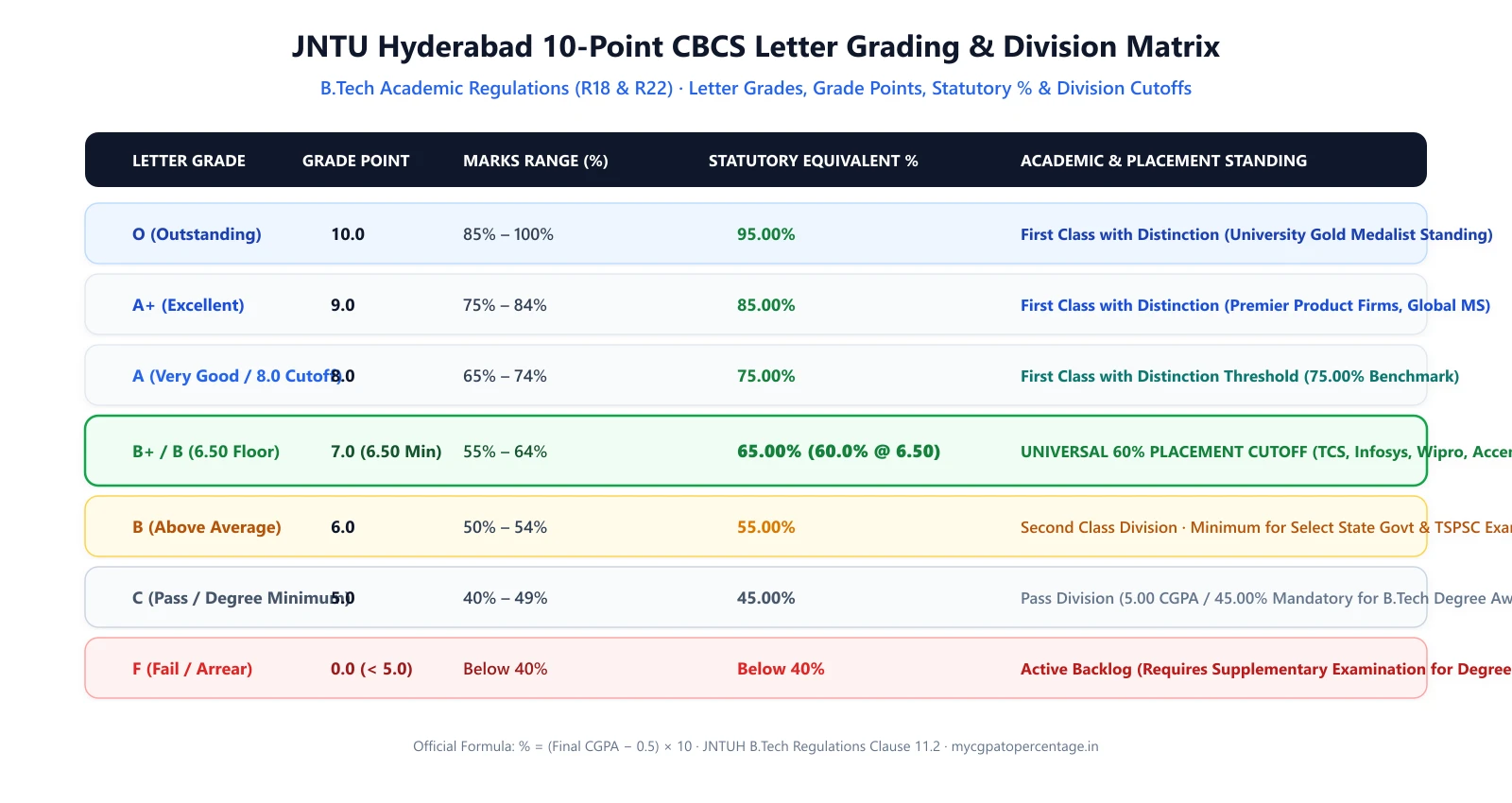
| Letter Grade | Grade Point (GP) | Marks Range (%) | Statutory Equivalent % | Academic Honours & Placement Relevance |
|---|---|---|---|---|
| O (Outstanding) | 10.0 | 85% – 100% | 95.00% | First Class with Distinction (University Gold Medalist Pool) |
| A+ (Excellent) | 9.0 | 75% – 84% | 85.00% | First Class with Distinction (Premier Product Tech & Global MS) |
| A (Very Good) | 8.0 | 65% – 74% | 75.00% | First Class with Distinction Threshold (75% Benchmark) |
| B+ (Good / 6.50 Min) | 7.0 (6.50 Min) | 55% – 64% | 65.00% (60.0% @ 6.50) | Universal Placement Eligibility Floor (TCS, Infosys, Wipro, Accenture) |
| B (Above Average) | 6.0 | 50% – 54% | 55.00% | Second Division Classification (Eligible for select state government jobs) |
| C (Pass Floor) | 5.0 | 40% – 49% | 45.00% | Pass Division (5.00 CGPA / 45.00% Mandatory for B.Tech Degree Award) |
| F (Fail / Arrear) | 0.0 | Below 40% | Below 40% | Active Course Backlog (Supplementary Examination Required for Clearance) |
*Statutory Ordinance Note: To graduate and receive a B.Tech degree from JNTUH, a candidate must secure at least Grade C (40% marks) in every single course and maintain an overall cumulative index of at least 5.00 CGPA (45.00% marks) with zero uncleared backlogs.
6. Step-by-Step Practical Calculation Scenarios & Real Data Walkthroughs
Scenario 1: Converting a 7.60 CGPA Score (How much is 7.60 CGPA in percentage?)
Students securing around 7.60 CGPA often need to confirm their exact standing for corporate registration portals:
- Step 1: Note your final CGPA from the Consolidated Marks Memo:
7.60 CGPA. - Step 2: Apply JNTUH Clause 11.2 offset:
7.60 − 0.50 = 7.10. - Step 3: Multiply the balance by 10:
7.10 × 10 = 71.00%. - Academic Standing: 71.00% (First Class Division). Safely clears screening cutoffs for tier-1 IT consulting and software product firms.
Scenario 2: High Honors & Distinction Benchmark (What is 8.70 CGPA in percentage?)
For ambitious students applying for global master's degrees (via WES) or high-frequency trading (HFT) interviews:
- Step 1: Record your cumulative score:
8.70 CGPA. - Step 2: Execute the formula:
(8.70 − 0.50) × 10 = 8.20 × 10 = 82.00%. - Academic Classification: 82.00% (First Class with Distinction). Guarantees top-percentile placement eligibility and streamlined international credential verification.
Scenario 3: Evaluating 7.45 & 7.50 CGPA (Is 7.5 CGPA Equal to 75%?)
Is 7.45 CGPA considered good at JNTUH?
Executing the conversion: (7.45 − 0.50) × 10 = 6.95 × 10 = 69.50%.
A 7.45 CGPA represents a strong, upper-quartile academic profile across JNTUH affiliated colleges. It comfortably clears the standard 60% and 65% screening bars for core engineering firms and multinational IT corporations.
Does 7.50 CGPA equal 75.00% marks?
No, it does not. Under JNTUH's official 0.5 deduction rule:(7.50 − 0.50) × 10 = 7.00 × 10 = 70.00%.
7.50 CGPA converts to exactly 70.00% marks. To achieve 75.00% (the Distinction threshold), an undergraduate must achieve a cumulative index of exactly 8.00 CGPA.
Scenario 4: Analyzing Marginal Scores (What is a 2.70 CGPA in percentage?)
Arithmetically, (2.70 − 0.50) × 10 = 22.00%. However, at JNTUH, an aggregate score of 2.70 represents severe academic deficiency. Under university regulations, a minimum cumulative grade point of 5.00 CGPA (Grade C / 45.00%) is required for degree award. A score of 2.70 indicates multiple active backlogs (Grade F), requiring supplementary examination clearance to attain the graduation floor.
7. JNTUH Ready-Reckoner Matrix: 4.50 to 10.00 CGPA
Quickly verify your calculated percentage and graduation honors against the official institutional reference chart:
| Cumulative CGPA / SGPA | Calculated Equivalent % | Degree Classification | Recruitment & Competitive Standing |
|---|---|---|---|
| 10.00 | 95.00% | First Class with Distinction (Honours) | University Gold Medalist Standing / Direct PhD Admissions |
| 9.50 | 90.00% | First Class with Distinction | High-Frequency Trading & Premier Product Tech Roles |
| 9.00 | 85.00% | First Class with Distinction | Direct Eligibility for Elite Global Master's Degrees |
| 8.70 | 82.00% | First Class with Distinction | Strong Standing for International Graduate Fellowships & WES |
| 8.50 | 80.00% | First Class with Distinction | Clears All Premium Core Engineering & Software Cutoffs |
| 8.00 | 75.00% | First Class with Distinction (Threshold) | Statutory Distinction Benchmark at JNTUH |
| 7.60 | 71.00% | First Class Division | Competitive Performance across Top Enterprise Software Drives |
| 7.50 | 70.00% | First Class Division | Solid Eligibility across Leading IT & Core Conglomerates |
| 7.00 | 65.00% | First Class Division | Standard PSU & Graduate Management Trainee Benchmark |
| 6.50 | 60.00% | First Class Division (Cutoff) | Universal 60% Corporate Campus Recruitment Floor |
| 6.00 | 55.00% | Second Class Division | Minimum Baseline for Specific State Engineering Exams |
| 5.50 | 50.00% | Second Class Division | Eligible for General Graduate Public Service Examinations |
| 5.00 | 45.00% | Pass Division (Degree Minimum) | Absolute Minimum Cumulative Index for Degree Conferral |
| < 5.00 | Below 45.00% | Academic Probation / Fail | Supplementary Examination Required to Attain 5.00 Floor |
8. TG EAMCET (TS EAMCET) Cutoff Ranks for JNTUH Main Campus (UCESTH)
For admission to the University College of Engineering Science & Technology Hyderabad (UCESTH - JNTUH Main Campus, Kukatpally), candidates must achieve top ranks in the state-level Telangana State Engineering, Agriculture & Medical Common Entrance Test (TG EAPCET / TS EAMCET). Below are the authentic opening and closing cutoff ranks for General (OC) category candidates:
| B.Tech Engineering Specialisation | Expected Cutoff Rank (OC Boys) | Expected Cutoff Rank (OC Girls) | Academic Competitiveness Standing |
|---|---|---|---|
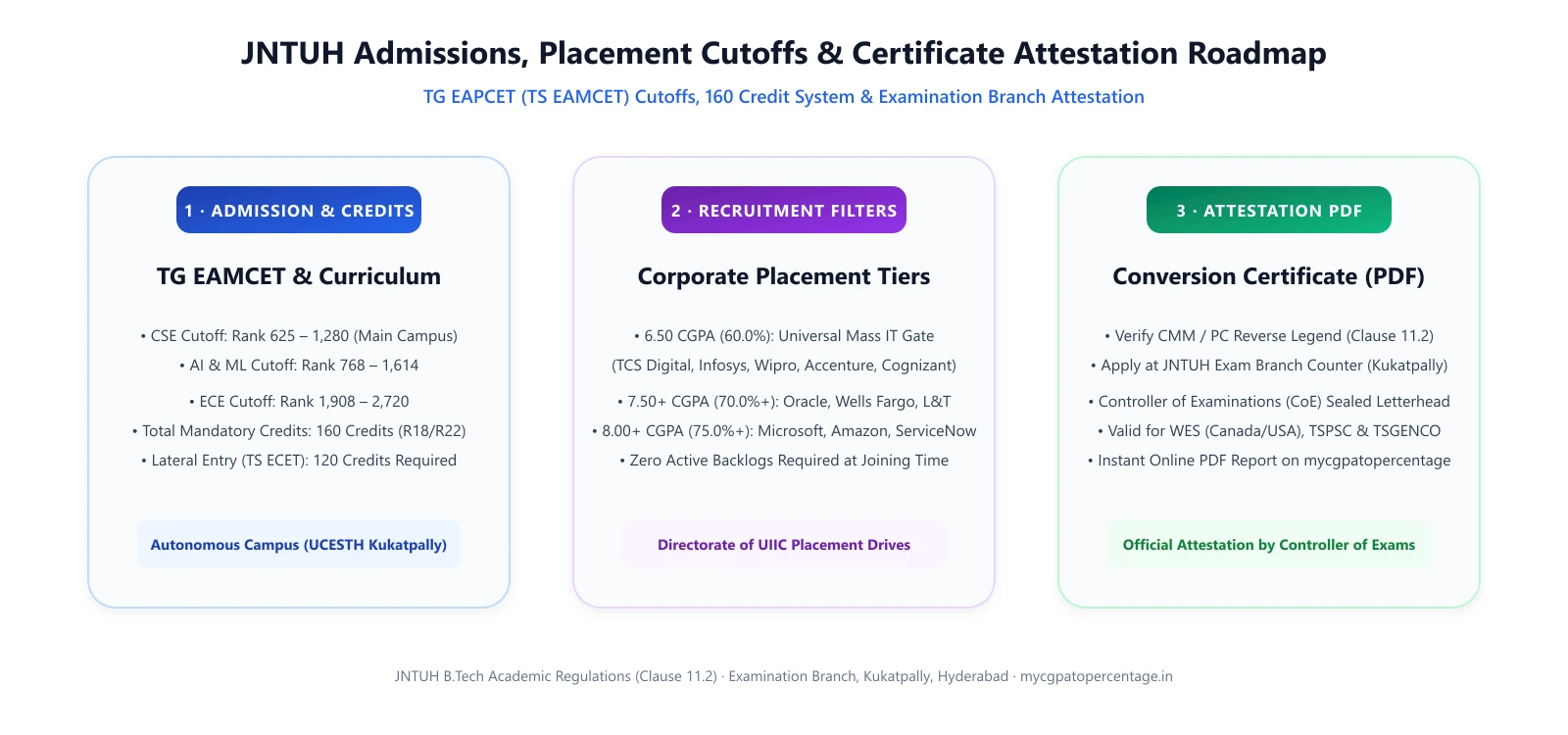
| Computer Science & Engineering (CSE) | 625 – 1,280 | 690 – 1,755 | Extremely Competitive (Top 0.5% State Percentile) |
| CSE (Artificial Intelligence & Machine Learning) | 768 – 1,614 | 1,220 – 2,400 | Premier Choice for High-Tech AI Specializations |
| Electronics & Communication Engineering (ECE) | 1,908 – 2,720 | 2,500 – 4,500 | Top-Tier Semiconductor & Core Embedded Stream |
| Electrical & Electronics Engineering (EEE) | 4,964 – 6,930 | 5,600 – 8,780 | Core Power Systems & Smart Grid Infrastructure |
| Mechanical Engineering | 7,905 – 9,580 | 12,400 – 16,100 | Heavy Industrial Engineering & Robotics Research |
| Civil Engineering | 10,320 – 11,030 | 11,340 – 12,660 | State Infrastructure & Structural Design Hub |
| Chemical Engineering | 12,280 – 14,500 | 13,750 – 16,800 | Process & Petrochemical Research Domain |
| Metallurgical Engineering | 24,500 – 28,000 | 23,400 – 33,000 | Specialized Advanced Materials Fabrication |
9. Critical Disambiguation: JNTUH vs. JNTUK vs. JNTUA vs. JNU Delhi
Students and recruiters often confuse similarly named institutions. It is crucial to understand their distinct legal jurisdictions and evaluation standards:
(Final CGPA − 0.5) × 10.10. Campus Placement Dynamics, Salary Trends & Corporate Screening Cutoffs
Campus recruitment at JNTUH connects students with major multinational technology and engineering corporations. Below are key compensation trends and placement screening cutoffs:
Tier-1 Product Engineering & High-Frequency Tech:
Global software powerhouses including Microsoft, Amazon, ServiceNow, Oracle, and Wells Fargo recruit primarily from CSE and ECE branches with eligibility floors ranging from 7.50 to 8.00+ CGPA (70.00% to 75.00% marks).
Enterprise IT & Core Manufacturing Recruiters:
Leading technology employers including TCS (Digital/Prime), Infosys, Wipro, Accenture, Cognizant, and Larsen & Toubro mandate an entry threshold of 6.50 CGPA (60.00% marks), alongside a requirement of zero active academic backlogs at the time of joining.
11. Procedure for Obtaining JNTUH Conversion Certificate (PDF)
When applying for foreign graduate evaluation (via WES Canada/USA), GATE admissions, or specialized public sector dossiers (TSPSC, TSGENCO, UPSC):
- Check Transcript Reverse Legend: Review the reverse side of your Consolidated Marks Memo (CMM) or Provisional Certificate (PC), where Clause 11.2 is explicitly cited.
- Visit JNTUH Examination Branch: Report to the Examination Branch Counter, Ground Floor, Administrative Building, JNTUH Kukatpally, Hyderabad – 500085.
- Fill Requisition Challan: Complete the prescribed application form for an official "CGPA-to-Percentage Equivalence Certificate" and pay the administrative processing fee.
- Attach Academic Records: Enclose photocopies of your Consolidated Grade Card, semester grade memos, and Degree / Provisional Certificate.
- Receive Stamped Attestation: The Controller of Examinations (CoE) issues a signed, sealed certificate affirming:
Equivalent Percentage = (Final CGPA − 0.5) × 10.
Formal Application for Percentage Conversion Certificate
Date: [Insert Application Date, e.g., 24th October 2026]

To,
The Controller of Examinations,
Examination Branch, Administrative Building,
Jawaharlal Nehru Technological University Hyderabad,
Kukatpally, Hyderabad, Telangana – 500085.

Subject: Request for Official Endorsement of CGPA-to-Percentage Equivalence Certificate

Respected Sir/Madam,

I am writing to formally request an official CGPA-to-Percentage conversion certificate affirming my academic performance at Jawaharlal Nehru Technological University Hyderabad (JNTUH). Having successfully fulfilled all curricular requirements in the Department of [Your Department, e.g., Computer Science & Engineering / Electronics & Communication Engineering] at [Your College Name, e.g., University College of Engineering Science & Technology Hyderabad / CBIT / VNR VJIET], I require an authorized attestation for higher studies / employment verification.

My academic registration details are as follows:
• Candidate Full Name: [Your Full Legal Name]
• Institute Hall Ticket / Roll Number: [Your JNTUH Roll Number, e.g., 22011A05XX]
• Academic Registration Number: [Your University Registration ID]
• Course & Degree: Bachelor of Technology (B.Tech)
• Academic Session / Batch: [e.g., 2022 – 2026]
• Academic Regulation: [e.g., R18 / R20 / R22 CBCS]
• Cumulative Grade Point Average (CGPA) Secured: [Your Final CGPA, e.g., 7.60]

In accordance with the statutory evaluation guidelines issued under Clause 11.2 of the JNTUH B.Tech Academic Regulations, the official mathematical equation for computing equivalent percentage of marks is:
Percentage (%) = (Final CGPA − 0.5) × 10

Based on this official university regulation, my cumulative percentage computes to:
([Your Final CGPA] − 0.5) × 10 = [Your Calculated Result]% Marks

Because my prospective employer / higher education institution [Specify Recruiter or University, e.g., TCS / Microsoft / WES Evaluation / TSPSC] mandates an attested certificate bearing university seals, I respectfully request the Examination Branch to issue an authorized certificate validating this equivalence.

Copies of my Consolidated Marks Memo (CMM) and Provisional Certificate (PC) are enclosed herewith for administrative verification.

Yours faithfully,

___________________________
(Signature of Candidate)
Full Name: [Your Full Name]
Hall Ticket Number: [Your Hall Ticket Number]
Contact Telephone: [Your Phone Number]
Email Address: [Your Email Address]
12. Recommended Academic Calculators & University Guides
13. Frequently Asked Questions (FAQs) — People Also Ask
Q1: How do I convert my CGPA to a percentage at JNTU Hyderabad?
Answer: To convert your CGPA to percentage at JNTUH, subtract 0.5 from your cumulative score and multiply by 10: Percentage (%) = (Final CGPA − 0.5) × 10. For example, an 8.00 CGPA converts to: (8.00 − 0.5) × 10 = 7.50 × 10 = 75.00%.
Q2: How much CGPA is required for 60 percent in JNTUH?
Answer: Exactly 6.50 CGPA equals 60.00% marks: (6.50 − 0.5) × 10 = 6.00 × 10 = 60.00%. This fulfills the corporate recruitment cutoff for TCS, Infosys, Wipro, Accenture, and Cognizant.
Q3: What is the minimum passing CGPA in JNTU Hyderabad?
Answer: Under JNTUH CBCS ordinances, each course requires a minimum Grade Point of 5 (Grade C / 40%), and an overall final CGPA of 5.00 (45.00% marks) is mandatory for graduation and award of the B.Tech degree.
Q4: Is JNTUH private or government?
Answer: JNTUH is a public state government technological university, established in 1972 by the State Legislature and operating under the Department of Higher Education, Government of Telangana.
Q5: How much rank is required in TS EAMCET for JNTU Hyderabad?
Answer: For regular admission to JNTUH Main Campus (UCESTH Kukatpally) in General Category (OC), closing ranks typically range from 625 to 1,280 for CSE, 1,200 to 2,400 for AI & ML, and 1,900 to 3,500 for ECE.
Q6: Can I join JNTU without EAMCET?
Answer: Regular B.Tech admissions to JNTUH constituent campus colleges are strictly based on TG EAPCET (TS EAMCET) counseling. However, polytechnic diploma holders can join directly into the 2nd year through TS ECET lateral entry. Private affiliated colleges also provide Management Quota (Category B) seats based on JEE Main or 10+2 marks.
Q7: Is JNTUH a Tier 1 college?
Answer: The University College of Engineering Science & Technology Hyderabad (UCESTH - JNTUH Main Campus, Kukatpally) is classified as an apex Tier-1 state government engineering institution in Telangana. Its private affiliated colleges generally fall into Tier-2 or Tier-3 classifications.
Q8: Is JNTU better than IIIT?
Answer: IIIT Hyderabad (IIIT-H) is an apex autonomous research institution for computer science with top software engineering packages. JNTUH Main Campus is a premier state government university offering comprehensive engineering streams with highly subsidized tuition fees and wide public sector standing.
Q9: How much is 7.60 CGPA in percentage at JNTUH?
Answer: A score of 7.60 CGPA converts to exactly 71.00% marks: (7.60 − 0.5) × 10 = 7.10 × 10 = 71.00% (awarded First Class Division).
Q10: Is 7.5 CGPA a 75 percentage at JNTUH?
Answer: No. Because of the 0.5 offset deduction, 7.50 CGPA equals 70.00% marks: (7.50 − 0.5) × 10 = 70.00%. Achieving 75.00% (Distinction floor) requires a cumulative index of 8.00 CGPA.
Q11: What is 8.7 CGPA in percentage at JNTUH?
Answer: An 8.70 CGPA converts to 82.00% marks: (8.70 − 0.5) × 10 = 8.20 × 10 = 82.00%, qualifying the student for First Class with Distinction (Honours).
Q12: What is a 2.7 CGPA in percentage at JNTUH?
Answer: Arithmetically, (2.70 − 0.5) × 10 = 22.00%. However, at JNTUH, a minimum cumulative score of 5.00 CGPA (Grade C / 45.00%) is required to graduate. A score of 2.70 indicates active backlogs (Grade F), requiring supplementary examination clearance.
Q13: Does JNTUH award grace marks for B.Tech degree completion?
Answer: Yes. Under specific academic condonation notifications, JNTUH allows grace marks up to 0.15% of the total degree maximum marks across all 4 years (approximately 9 to 12 marks total) for final-year outgoing students failing in up to 3 theory subjects to complete their degree.
Q14: How many total credit points are required for a B.Tech degree at JNTUH?
Answer: Under JNTUH CBCS regulations (R18 and R22), students must accumulate exactly 160 total credits over 8 semesters for a regular B.Tech degree, or 120 credits over 6 semesters for lateral entry diploma candidates admitted via TS ECET.
Official Institutional & Regulatory Citations:
- • Jawaharlal Nehru Technological University Hyderabad Official Portal (jntuh.ac.in)
- • Official JNTUH B.Tech Academic Regulations (Clause 11.2 Equivalence PDF)
- • Telangana State Council of Higher Education (TGCHE / TG EAPCET)
- • All India Council for Technical Education (AICTE), New Delhi
- • Ministry of Education (MoE), Government of India